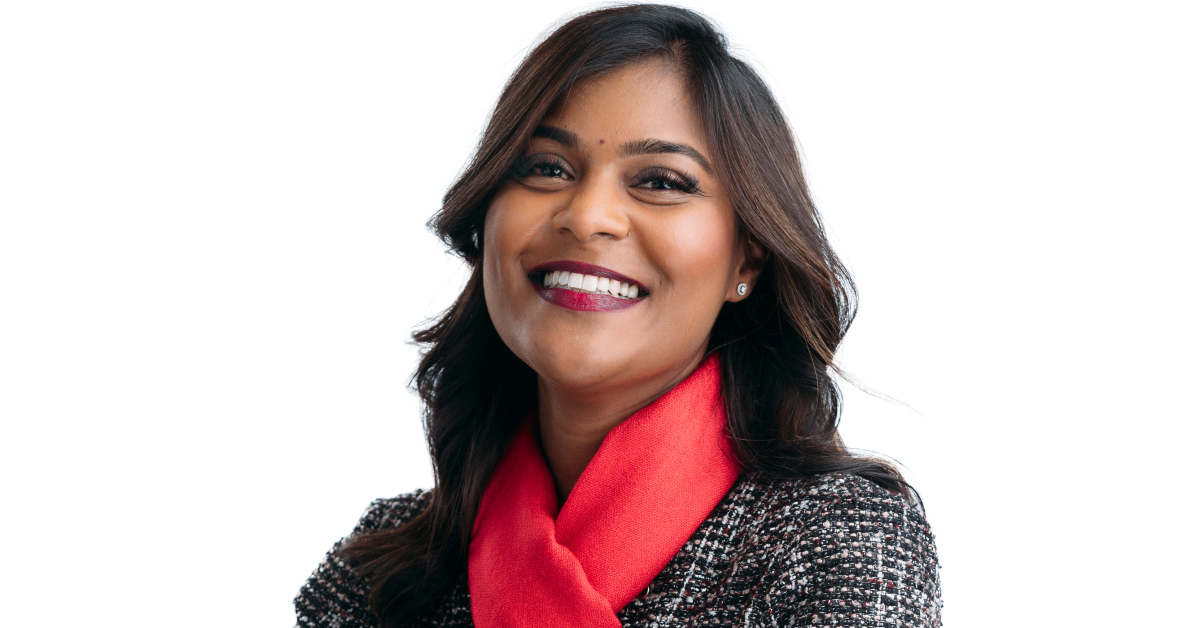
As part of our #WM2026 Career Progression series, Womenontop speaks to Marusha Nariansamy, Head of Actuarial at glu, about her journey to leadership in one of the financial sector’s most analytical and dynamic professions. She shares the experiences that have shaped her career, the importance of continuous learning, and her advice for women aspiring to build successful careers in finance, actuarial science, and leadership.
1. Can you take us through your career journey and the milestones that shaped your professional growth?
My career path started with a radio interview at 7 a.m. on my way to the orthodontist. I was 13, sitting in my dad’s car, half-asleep, when a local radio station presenter was interviewing a recent graduate about a profession I’d never heard of: actuarial science. Two things stuck: you had to be exceptional at maths, and actuaries made financial sense of the future. That was it. That was enough for me.
A few weeks later, I told my high school teacher I wanted to pursue it. He literally shook his head. “Don’t do that,” he said. “The smartest students from this school never made it past first year. Study medicine instead.” That’s the moment something clicked inside me. If it was that hard, I had to at least try.
I worked exceptionally hard at school, completed matric with 7 Distinctions, and secured a fully paid scholarship. Then university nearly broke me. There were nights when I genuinely questioned whether I could do this. But I kept showing up and completed the degree.
I was placed in a junior role in the middle of an economic recession, and spent my days working twice as hard as my peers to earn more work and learn faster. When an opportunity in consulting came up, I took it and loved it. I learned quickly from the brilliant colleagues around me. I learned how to engage with clients, simplify complex concepts, and present to boards tasks I’d never done before. My mantra at the time: do it scared, do it uncertain, do it even before you know you’re ready.
And then, at 29, I got the opportunity of a lifetime. I was asked to build an internal actuarial function from scratch. Just me. A blank page. Zero team. Massive expectations.
I buried myself in legislation, dissected technical documents, pieced together calculations that didn’t exist yet. There were moments of profound isolation. But I discovered something crucial: complexity isn’t something to fear; it’s an invitation to solve. Step by step, I built something from nothing, and in doing that, I stopped being someone who merely calculates risk. I became someone who helps organisations respond to it in ways that actually matter to real people.
That’s when I understood my purpose.
2. What strategies have helped you advance your career in a competitive corporate environment?
I showed up prepared and didn’t wait for permission. I didn’t wait to be invited to strategy conversations. I walked in with insights, asked the hard questions, and proved through my work that I deserved the seat. I put in late nights, endured steep learning curves, and in moments of tiring perseverance I leaned into my parents’ voice in my head. They never let circumstances define what was possible. They instilled discipline, resilience, and integrity. In those uncertain moments, I’d think about their steady steer, their unwavering belief in me, and I’d keep going.
3. What skills do you believe are becoming increasingly important for future business leaders?
Leadership is shifting from having the answers to asking the right questions, translating them into meaning for others, and doing all of it as your authentic self.
That shift starts with courage, the courage to ask hard questions, and the intellectual rigour to actually answer them. Technical brilliance alone isn’t enough anymore. You can be the smartest person in the room and still fail if you can’t connect with people. What’s needed now is the ability to translate complexity into meaning – to show people why something matters, and to instinctively ask what the second- and third-order effects of a decision will be, not just on the organisation, but on the wider community.
But clarity without authenticity rings hollow. People can sense inauthenticity from a mile away. The leaders I admire most show up as themselves, admit what they don’t know, and lead with integrity even when it costs them something. That’s rare. That’s powerful.
4. Have you experienced setbacks or moments of self-doubt, and how did you move forward?
I’ve stood in my office at midnight, staring at a problem I’d never encountered, with no one to call, thinking: Can I actually do this?
Imposter syndrome is real, and whenever self-doubt crept in, I forced myself to audit the facts objectively: projects completed, measurable outcomes, performance metrics, the tangible value delivered. I started keeping a running archive of achievements, certifications, and positive feedback, which served as a factual counterweight to my internal anxiety. Reviewing it regularly shifted my narrative to “Here’s what I’ve actually built.”
I broke the cycle of isolation by opening transparent conversations with mentors and trusted peers. I admitted my fears. And discovered something crucial: I wasn’t alone. Everyone else was wrestling with these doubts too; they just didn’t talk about it. By normalising the struggle instead of hiding it, I transformed fear of failure into fuel for learning.
Now when doubt shows up and it still does I have three things: evidence of my track record, mentors who remind me of my worth, and the knowing that struggling doesn’t mean I’m not good enough. It means I’m growing.
5. How do you balance delivering business results while staying true to your personal values?
I work in life insurance because I see it as a vehicle for social change. Financial protection breaks cycles of poverty. When families have financial security, children stay in school after a parent dies. Families don’t lose their homes. Wealth can start accumulating across generations instead of being wiped out by crisis.
So, when I’m designing a product, I’m not just asking, “Does this maximise profit?” I’m asking, “Does this deliver real value to the families who depend on us? Is this product accessible and affordable? The paradox is that this approach produces better and more sustainable outcomes for the business, and products that people actually trust and use.
6. What role has mentorship, sponsorship or networking played in your career?
I met my mentor, Bilal Adam, at 29. He showed me how to think strategically, how to bridge the gap between deep analysis and business commercial realities, and how to lead with both rigour and humanity.
But what mattered most is that my mentor believed in me before I believed in myself. When I was uncertain, he was steady. When I doubted, he challenged me forward. He showed me what integrity and excellence actually look like in practice. It was that foundation that shaped everything about how I lead today.
I’ve also been deliberate about building relationships across the organisation. Not networking in the transactional sense, but actual relationships built on genuine mutual respect. These people taught me how different departments operate, challenges they face, and how my work affects theirs. It made me exponentially better at my job.
I now mentor others; I push people to grow, I stand in their corner, I show them it’s possible to lead authentically and still succeed spectacularly. The truth is that I didn’t get here alone. And no one else will either.
7. How do you continue investing in your professional development?
I invest in two things: staying obsessively curious about my craft, and deliberately seeking out discomfort. On the technical side, I’m constantly asking: What’s shifting in our industry? What risks are emerging? What new tools or methodologies should I be mastering next? I follow industry trends closely and stay engaged with my peers. But above all, I refuse to assume I know everything; I stay eternally eager to learn more.
I believe that bigger growth happens outside your comfort zone. I’ve taken on leadership roles that stretched me in ways I didn’t feel ready for: building teams, navigating organisational change, shaping strategy. Self-reflection has been central to that growth journey, doing the work but also pausing to think about what you’re learning, what you could be getting wrong, and how to adjust course when needed. Fail forward, fail fast that’s what turns experience into actual growth.
8. What advice would you give to women aiming to accelerate their careers in corporate South Africa?
First: believe in your ability to figure it out, even when you have no idea how. Success isn’t about how naturally gifted you are. It’s about how much time, effort, and dedication you’re willing to invest. If you keep showing up and doing the work, you will get there. Full stop.
Second: don’t let imposter syndrome be your excuse to stay small.
You’ll feel it. I felt it in senior leadership roles at 29, often the only woman in the room. But feeling it and letting it stop you are two different things. Trust yourself, keep a record of your wins. Show up prepared. Put in the work that equips you to contribute meaningfully. Then stand in your strength.
Third: seek out challenges that terrify you (just a little).
Be willing to put yourself in rooms where you feel out of place. Then prove you deserve to be there by showing up prepared and confident in your abilities. That’s how you grow.
And finally: never underestimate the power of relationships.
Find mentors who will push you and stand by you. When you climb, pull others up. Your technical skills will open the door, but your resilience, integrity, and ability to inspire people that’s what keeps you in the room. That’s what makes you a leader worth following.
South Africa needs strong women paving the way into a better future. Don’t wait for permission. Show up.