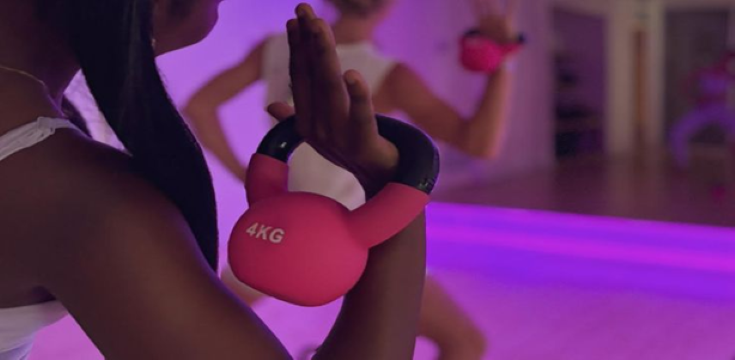
They look like cannonballs with handles, and the exercises people do look very different from any other weight training. These unique characteristics are the reason more South Africans are wondering whether kettlebells should form part of their fitness journey. The use of kettlebells in resistance training began in the 18th century, when Russian strongmen trained with the counterweights found in markets to build strength.
Modern kettlebell training has far less to do with brute force and far more to do with how your body moves holistically when you train with them. Kettlebell routines are also not just for elite and lifestyle athletes wanting to build strength. Active women and men from a range of ages are trying them out and finding benefits beyond strengthening.
What makes kettlebells different?
Unlike dumbbells, a kettlebell’s weight sits below its handle, creating an offset centre of gravity. That design forces your body to constantly adjust to a shifting load. This means the signature movements like swings, cleans, and snatches are dynamic demanding coordination, balance, and control from your full body.
Traditional weight training enables you to build certain muscles really well without engaging your core or stability muscles. It’s very one-dimensional. It’s the way to go if you want to look like a bodybuilder, but not great for enhancing everyday function and mobility. By contrast, a kettlebell routine empowers you to use your entire body, all your muscles.
Your range of motion, flexibility, and balance improve, and your core and lower back muscles get stronger while building muscle. This makes it an ideal workout for those who are focusing on building functional strength that supports their everyday lives.
Research supports the benefits
A study published in the Journal of Strength and Conditioning Research found kettlebell swing training improves maximal and explosive strength, particularly activating the posterior chain, which refers to the muscles along the back of the body, including the glutes and hamstrings (Lake & Lauder, 2012). This study also dispelled the notion that lighter kettlebells were insufficient for building strength. Another study in the same journal showed kettlebell workouts can elevate heart rate significantly, delivering cardiovascular benefits alongside strength gains (Farrar et al., 2010).
Thinking about kettlebell training? – Don’t go it alone…
Kettlebell routines consist of compound, high-intensity movements, including swings, snatches, and cleans. There are also strength-focused, foundational exercises such as goblet squats, Turkish get-ups, lunges, and overhead presses, which target the posterior chain and shoulders. If you are new to kettlebells, it is important to work with a professional instructor. While the movements are not necessarily hard to learn, you should work with an experienced guide to ensure safety and proper form.
Kettlebell routines can benefit women wanting to build strength, muscle mass, and bone density. They can also support older adults who are focused on building functional strength, as well as improving core stability and balance to prevent injury. For those focused on their social wellness, kettlebell workouts such as One Flow’s Sculpt Kettlebell bring you into a like-minded community where you find motivation and support in achieving your fitness goals.
Unlike traditional weight training, where you move from machine to weight rack in isolation, kettlebell sessions are shared, coached, and experienced together. The rhythm of swings, the focus of a clean, the collective push through a timed set, it all creates a sense of momentum that’s both physical and social.
The result is strength training that feels connected rather than competitive. You don’t just leave stronger; you leave having moved with others and shared in something bigger than a solo workout.
Visit www.oneflow.co.za for more information.