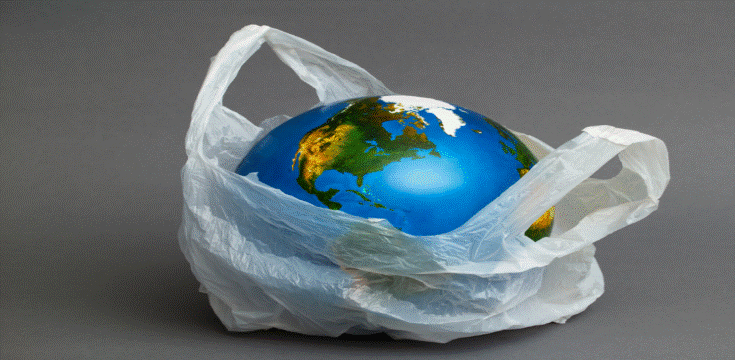
Each year in July, people across the globe take part in “Plastic Free July”. An international movement that aims to reduce the amount of plastic waste in our environment by encouraging fellow citizens to make the shift toward long-term, environmentally-friendly habits. Although skeptics might find it hard to believe, the plastics industry around the world supports these objectives.
Whilst we don’t endorse the call for people to go “plastic-free”, we do support the appeal for a plastic-free environment. To this end, we are advocating for a science-based, complementary plastic strategy. One that seeks to eradicate unnecessary plastic and considers the overall environmental impact of various plastic alternatives.
A more visible pollutant
To imagine that the solution to our country’s waste crisis is as easy as simply banning the use of plastics is an uninformed, irrational argument that can be perilous to the environment that we are trying to protect. It is important to recognise that the waste clogging our rivers, streams, and oceans is not solely caused by plastics. Because plastics are lightweight material, it floats and is therefore often the more visible pollutant. This has caused the plastics industry to have a big target on its back.
It is a fact that our modern lives would be virtually impossible without the use of plastics. Almost every sector or industry relies on plastics to make life easier, safer, and more convenient. Plastics give us reliable performance at an affordable price. Think about the many applications of plastics in the healthcare environment, automotive industry, technology, building and construction, and mining.
Over the past few years, numerous independent scientific studies have been conducted to compare the environmental footprint of plastics versus other packaging materials. E.g. glass, paper, or biodegradable packaging. Time and again, these life cycle analyses have proven that plastics require less energy, reduce waste, and have lower carbon emissions.
Repurposed and recycled into something new?
Earlier this year the World Economic Forum admitted that “in trying to solve the plastic pollution problem, we may have created another problem, We are replacing plastic with materials that have a carbon footprint up to 3 times higher than plastics themselves. Some of which are not even biodegradable in real-life conditions”. In 2020 the CSIR released their findings that confirmed that reusable, plastic shopping bags are the best option for South Africa.
Some of society’s biggest challenges are being addressed with the help of plastics – including improving medical outcomes, access to fresh and healthy foods, hygiene and sanitation, modern communication, transportation systems, infrastructure, and employment.
Unfortunately, all of these benefits are jeopardized if plastic waste pollutes our environment. The real issue that should therefore be addressed is not the use of plastics, but human behaviour and the country’s broken waste collection and recycling systems.
The reality is that if we do not fix this “broken waste management system” all our other efforts will be less effective and even wasteful and fruitless activities. We can have the best-redesigned product that is 100% recyclable. However, if it is not separated at the household level and moved to a central place where it can be sorted for recycling then (with the current broken system) it will just end up in a landfill or the environment.
Every piece of plastic has value and has the potential to be repurposed and recycled into something new. Whilst a battle rages on around the issue of litter in the environment, Plastics SA and its members will continue to make a tangible difference through various clean-up operations and initiatives that help to keep our country’s river-catchment areas clean of plastic waste.