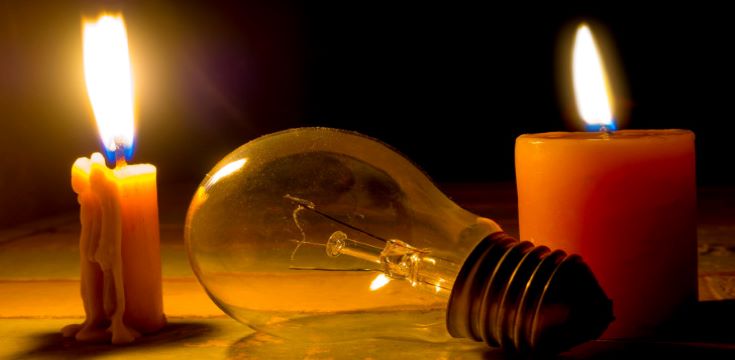
Eskom says that the risk of continued load shedding up until the end of March 2022 remains high and that South Africa could see a further 61 days of load shedding between 1 April 2022 – 31 August 2022. However, load shedding doesn’t have to leave us feeling powerless. So says Orlando Luis, CEO of Brights Hardware who has put together a list of suggestions and product tips to help you see that there is light at the end of the tunnel and help you navigate through ongoing power cuts.
Make light of it
“Candles create a wonderful mood but there are far safer ways of lighting your home during power cuts that do not present the danger of a fire,” says Orlando Luis CEO of Brights, who has provided a list of possible alternative solutions to light your way.
Battery-powered LED lighting
There is a wide range of rechargeable battery powered light strips, lanterns, desk lights and torches available that make keeping the lights on during load-shedding easy. Most of these items have a 1year warranty look out for options with Li-ion Battery technology.
“Rechargeable LED lights are recommended as batteries can become expensive. But just be sure to plug them in to recharge again once the power is back on,” says Luis.
Smart LED lights
“Smart LED bulbs make keeping the lights on during load shedding a seamless process as they stay on during power cuts. The bulbs hold charge for up to four hours and come in either a screw or bayonet configuration.”
Solar lighting
“Like the rechargeable solutions, there is also a wide range of solar-powered lighting options on the market today,” says Luis. “These vary from spotlights/security lights to solar lanterns, garden lighting and even pool lights. Solar-powered lighting is a great solution in a sun-rich country such as ours, but remember to keep them out of shaded areas, preferably on a north facing wall to get a complete charge.”
“There is no cost to recharge them, and many are practically ‘set and forget’ and will come on automatically after sundown.”
Working nine to five
With so many people working from home these days, loadshedding can be a huge inconvenience and dampener on productivity if you are unable to use your computer, connect to the internet or your devices.
Luis advises that there are various option available to make sure you can keep working during loadshedding.
Portable power bank
“Portable power banks are a fantastic solution to ensure that you don’t run out of cell phone battery life. These compact gadgets can also charge other devices such as tablets, portable modems, and speakers.”
Uninterruptible Power Supply
“Equipping yourself with a UPS is the ideal way to ensure the smooth running of your home office and internet connection. In the event of a power cut, the UPS acts like a battery backup, taking over the power supply and ensuring a current to all your home equipment – keeping your computer, modem, printer, speakers, microphone, and webcam operational,” says Luis.
“A 600-watt, 12-volt unit that is perfect for your home electronics. This unit requires one deep cycle battery. The next size up is the 1 000-watt 24-volt inverter which requires two deep cycle batteries. All of these have a 1 year warranty.”
Taking loadshedding with a pinch of salt
Load shedding often occurs during the times you would be preparing food for yourself or your family and boiling water or getting meals prepared during power outages is impossible without a gas stove or cooker.
“Because of this many people are choosing to change their ovens over from electrical to gas. Not only does this mean you can carry on your dinner preparations during a power outage, but your electricity bill will also be reduced through the introduction of gas appliances,” says Luis.
“Thankfully there are many different options available to consumers today, whether it is a large gas hob and oven or just a simple, portable table-top one or two-plate gas cooker and many more options in between.”
The bigger picture
Luis advises that a great way to truly minimise the impact of loadshedding on your life, in addition to the ideas set out above, is to invest in a generator, inverter or solar energy for your home – if budget allows.
A generator
There are many different models and options of generators to consider,” says Luis. “Entry-level two-stroke generators, such as a 950-watt unit, are unreliable if the petrol/oil mixture is not consistent, so Brights recommends starting with no lower than a four-stroke generator.”
Luis adds that the higher the wattage of the generator the more power it outputs and so the more electricity it generates.
Inverters – because silence is golden
Pure sine wave inverters with batteries are silent and they switch on automatically during load-shedding.
Solar energy
“Setting up a solar solution isn’t exactly cheap, but the costs can quickly be recovered, and you will be free of the frustration that goes with power outages. Start small with a few panels and deep-cycle batteries to keep the bare essentials running.”
Luis explains that you can build your solar installation up over time, adding additional solar panels and deep cycle batteries as time and budget allows. “The bigger the installation, the more power it will generate, meaning you can run more lights and appliances from this solar energy, and run them for longer.”
For more visit: www.brights.co.za