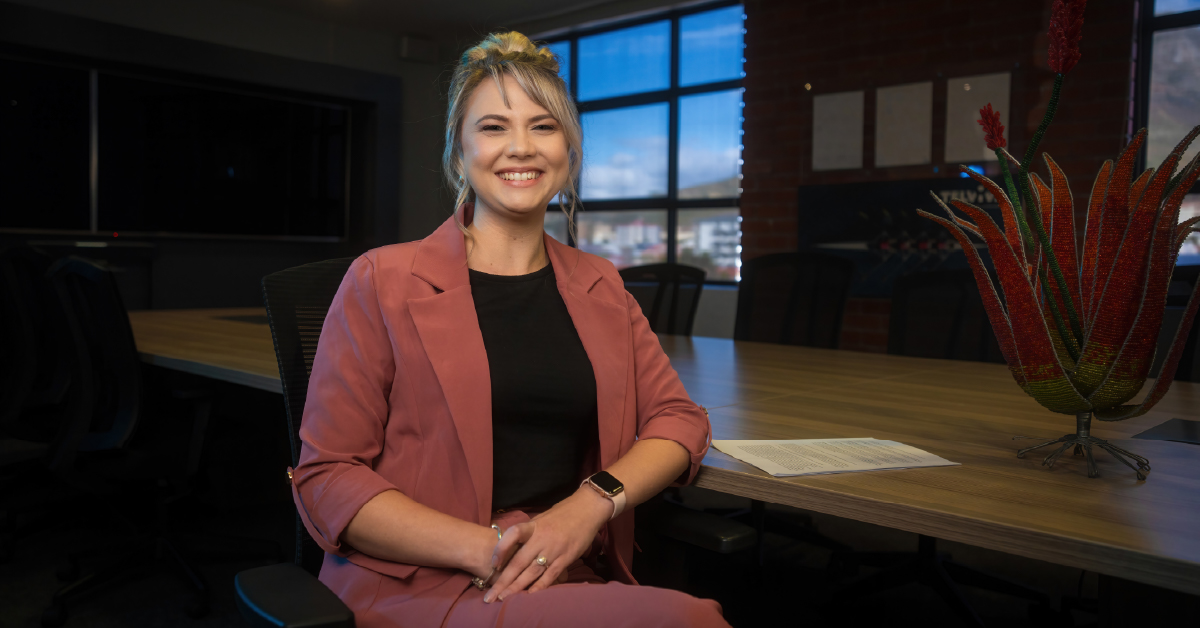
From starting her career as a receptionist to leading revenue strategy for one of South Africa’s leading cloud communications companies, Telviva’s Chief Revenue Officer has built her success through determination, continuous learning, and a willingness to embrace every opportunity. Her journey is a testament to the power of perseverance, proving that career growth is shaped not by where you begin, but by the commitment and resilience you bring along the way.
1. Can you take us through your career journey and what led you to your current role as Chief Revenue Officer at Telviva?
When I started as a receptionist in 2012, I didn’t have a fast track or a grand corporate plan. What I did have was a commitment to showing up, learning fast, and refusing to let where I started define how far I could go. From front-of-house to account management to building a national accounts division, I’ve worked through every layer of business. Now, as CRO at Telviva, I look back on that decade of grit with immense gratitude. This role isn’t just a title to me; it represents years of hard work and the incredible network of people who believed in me and helped me clear the path.
2. What initially drew you to the telecommunications and sales operations sector, and what has kept you passionate about it over the years?
I didn’t enter this industry because of a calling; I entered it through circumstance. My original dream was film production. When that path didn’t materialise, I found myself in the corporate world much earlier than expected, figuring things out in real-time. What I discovered along the way was a natural ability to connect with people and decode their needs, and I found that telecoms and cloud communications provided the perfect canvas for that skill set.
For me, passion followed competence. I got good at the work, grew to love it, and the fast-paced evolution of the industry has kept me engaged ever since. Sometimes, the path you didn’t choose turns out to be exactly where you belong.
3. Your role spans strategy, revenue growth, and service leadership. What does a typical day look like for you?
When people ask about the role, I always say it’s ‘full’, but it’s also incredibly fulfilling. A typical week means balancing commercial strategy and product alignment with sales enablement and client relationships. There’s no quiet time. Because my career was built in high-pressure environments, I’ve developed the stamina to pivot between priorities without losing focus on what matters most. For me, human connection is the thread that ties all of these moving parts together, and it’s what keeps me anchored.
4. What have been some of the most defining moments in your career that shaped your leadership style?
Looking back, my most transformative chapters weren’t the victories. They were the “lean seasons”, the times I had to dig deep and navigate intense pressure with minimal resources. If building from the ground up taught me anything, it’s that resilience isn’t something you simply have or don’t have. It is a practice. You choose it, intentionally, precisely when it is hardest to do so. Those testing periods built a resilience in me that no amount of easy success could ever replicate.
5. As a leader responsible for revenue growth, how do you balance driving commercial targets with building long-term customer relationships?
I have never been able to separate the two, and I think that instinct has served me well. I came up through account management, which means I have always understood that the real work begins after the sale. Chasing a number at the expense of a relationship is a short game. I am not built for short games. The discipline of doing right by the client, even when it costs something in the short term, is what builds the kind of commercial foundation that actually holds.
6. What leadership lessons have you learned that you wish you had known earlier in your career?
Hard work is a prerequisite for success, but it isn’t the whole equation. For years, my focus was entirely on execution. But the real shift happened when I stopped relying solely on grit and started investing in my voice, influential communication, and organisational navigation. The hardest skill to learn wasn’t how to do the work, but how to let go of it, a humbling lesson in leadership that completely changed how I operate.
7. How do you approach innovation and digital enablement in a fast-evolving technology landscape?
Curiosity first, pragmatism always. While working in AI-powered communication right now is extraordinary, I’ve never been dazzled by technology for its own sake. To me, tech is only as valuable as the real-world problem it solves. Whether managing cloud communications a decade ago or scaling AI solutions today, my discipline remains identical: understand the problem deeply, then build the solution. Innovation moves fast, but that core focus never changes.
8. What advice would you give to women aspiring to senior leadership roles in traditionally male-dominated industries like tech and telecoms?
The corporate culture in these sectors can often feel unfair and dominated by alpha personalities. You do not need to mimic that style to be effective. Winning in tech and telecoms isn’t about having a flawless, pre-designed career map. It’s about having the stamina to endure the friction, the wisdom to know when to listen, and the courage to forge your own trail.
9. How do you personally define success, and has that definition changed over time?
Early in my career, I measured success by what I could achieve. Now I measure it by what I leave behind, professionally and at home. What has changed is the lens. I am a mother, a wife, and a leader, and I have had to learn, sometimes the hard way, that you cannot pour from an empty cup. The determination has not dimmed. But it is more considered than it used to be.
10. What legacy do you hope to leave through your work at Telviva and in your broader career?
I hope to be remembered as someone who built things that lasted and did so with integrity. Teams that kept performing, clients that were genuinely well served, and commercial foundations that outlived my direct involvement. Beyond that, I hope my career demonstrates that there is no single profile for executive leadership. I started as a receptionist and worked my way to the C-suite without a conventional route. If that trajectory gives someone else permission to back themselves and keep going, that is a legacy I would be proud of.